For many Nigerian businesses, generators have become more than backup power, they’ve become part of the business model.
From restaurants and hotels to hospitals, banks, manufacturing plants, retail stores, and corporate offices, the familiar sound of a generator is often treated as the soundtrack of doing business. Fuel deliveries are budgeted. Maintenance schedules are expected. Generator repairs are accepted as “one of those things.”
But here’s the uncomfortable truth:
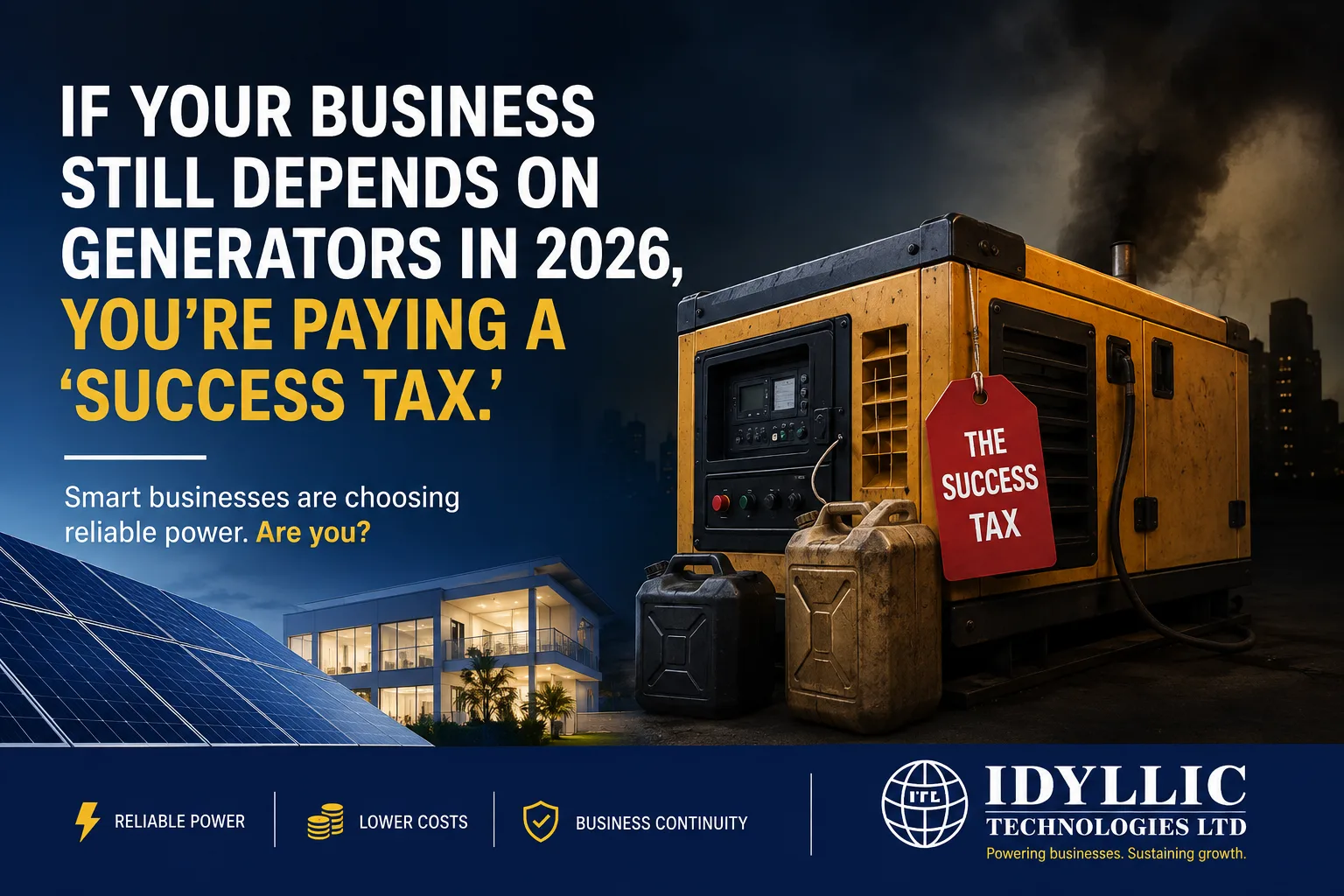
If your business still relies on generators as its primary power strategy in 2026, you’re paying what can only be described as a Success Tax.
Not because generators are bad.
But because every time your business grows, your generator costs grow with it.
What Is a Success Tax?
A Success Tax is an expense that increases simply because your business is doing well.
Imagine this:
You open a second branch.
Your electricity demand doubles.
Your generator now runs longer.
Fuel consumption increases.
Maintenance becomes more frequent.
You may even need a larger generator.
Your business is growing—but so are your energy costs.
Growth should improve profitability, not multiply operating expenses.
Yet for thousands of businesses, every milestone comes with another fuel bill.
The Generator Trap
Most businesses didn’t choose generators because they were the smartest long-term investment.
They chose them because they were the quickest solution.
Years later, that temporary solution has quietly become permanent.
The problem is that generators create a cycle that’s difficult to escape.
Every litre of diesel or petrol burned is money that disappears forever.
Every oil change is another unavoidable expense.
Every breakdown interrupts operations.
Every spike in fuel prices immediately affects your bottom line.
Unlike many business investments, generators rarely become cheaper to operate over time.
They become more expensive.
The Hidden Costs You Don’t See
When business owners think about generator expenses, they usually think about fuel.
But fuel is only part of the story.
There are costs that don’t appear on receipts.
Staff productivity drops when power fails unexpectedly.
Customers become frustrated when service slows down.
Sensitive equipment wears out from unstable electricity.
Maintenance teams spend valuable hours fixing preventable issues.
Business owners lose time managing power instead of growing the business.
These hidden costs rarely appear in financial statements, but they quietly reduce profitability every single day.
The Businesses Pulling Ahead
Across Nigeria, many businesses are changing the way they think about energy.
Instead of asking,
“How do we buy more fuel?”
They’re asking,
“How do we reduce our dependence on fuel altogether?”
That’s an entirely different conversation.
Hotels are reducing generator runtime.
Corporate offices are installing hybrid power systems.
Healthcare facilities are investing in uninterrupted power to protect critical equipment.
Manufacturers are looking for ways to stabilise production while controlling energy costs.
These businesses haven’t discovered a magic solution.
They’ve simply realised that energy should be a strategic investment—not a recurring emergency.
Reliable Power Is a Competitive Advantage
Power isn’t just about keeping the lights on.
It’s about serving customers without interruption.
It’s about protecting equipment.
It’s about helping employees stay productive.
It’s about delivering on promises.
Businesses with reliable power respond faster, operate longer, reduce downtime, and create better customer experiences.
That’s not just an operational benefit.
It’s a competitive advantage.
The Better Question
Many business owners still ask:
“How much does a solar system cost?”
A more useful question might be:
“How much has unreliable power already cost my business?”
Lost sales.
Delayed production.
Equipment damage.
Customer dissatisfaction.
Fuel.
Maintenance.
Emergency repairs.
When viewed over several years, the answer is often far greater than expected.
Building an Energy Strategy Instead of an Energy Habit
There’s nothing wrong with having a generator.
In fact, generators still have an important role as backup power in many organisations.
The problem begins when they become your only strategy.
Modern businesses need an energy plan that balances reliability, efficiency, and long-term cost control.
For many organisations, that means combining solar, battery storage, inverters, and backup systems into a solution designed around how the business actually operates.
The goal isn’t to eliminate generators overnight.
The goal is to rely on them less and spend less because of it.
Final Thoughts
The businesses that will lead tomorrow aren’t necessarily those with the biggest buildings or the largest workforce.
They’re the ones making smarter operational decisions today.
Reliable power is no longer just an operational necessity, it has become a business advantage.
So perhaps the real question isn’t whether your generator still works.
It’s whether your business should still depend on it.
At Idyllic Technologies, we help businesses design reliable energy solutions that reduce downtime, improve efficiency, and lower long-term operating costs. Whether you’re looking to supplement your existing power system or explore a transition to solar and backup energy solutions, our team is ready to help you find the right approach for your business.
Because success should increase your profits, not your fuel bills.