When the power goes out, most businesses immediately think about the cost of turning on the generator.
Fuel.
Maintenance.
Diesel.
But what if the generator cost is actually the smaller part of the problem?
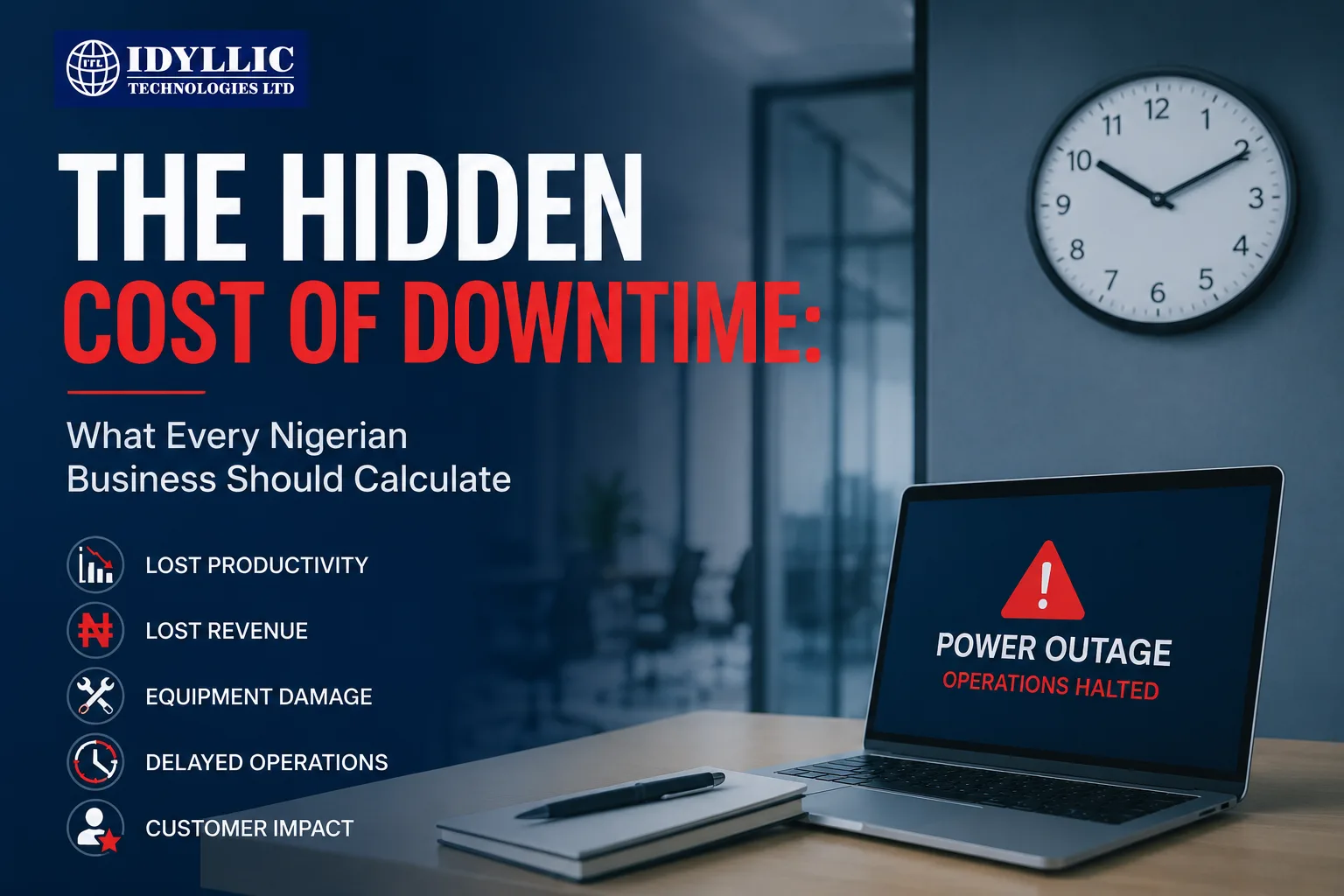
For many Nigerian businesses, the real cost of unreliable power is not found on a fuel receipt or electricity bill. It is hidden in lost productivity, interrupted operations, missed sales, delayed services, equipment downtime and frustrated customers.
And because these costs are rarely calculated, businesses often underestimate how much unreliable power is actually costing them.
What Is Business Downtime?
Business downtime occurs whenever your organisation cannot operate normally because an essential system, process or piece of equipment is unavailable.
Power interruptions are one of the most common causes.
An outage can stop:
Computers and IT systems
Internet and communication systems
Air conditioning
Production equipment
Refrigeration
Payment systems
Security systems
Elevators and building systems
Medical or specialised equipment
Other critical business operations
Even when a generator eventually restores power, the interruption itself can still have a financial impact.
A business may be technically “back on,” but the losses may have already happened.
The Cost of Downtime Goes Beyond Electricity
Imagine an office experiences a two-hour power interruption.
The obvious cost might be the diesel used to run the generator.
But consider what else could happen during those two hours.
Employees may be unable to work efficiently.
A customer transaction may be delayed.
An online meeting may be interrupted.
A production process may stop.
A client may leave because a service cannot be completed.
A refrigerated product may be exposed to unsuitable temperatures.
An IT system may require additional time to restart.
Now multiply those losses across several outages every month.
Suddenly, the cost of unreliable power looks very different.
1. Lost Employee Productivity
Your employees are one of your biggest business investments.
When power goes out and essential systems stop working, employees may be unable to perform their normal tasks.
Even when some employees can continue working, productivity can drop because of:
Poor lighting
Heat and discomfort
Loss of internet connectivity
Computers going offline
Interrupted meetings
Slow equipment
System restarts
If 20 employees lose one productive hour during an outage, that is already 20 working hours affected.
And that is before considering the other operational costs.
2. Lost Sales and Revenue
For businesses that depend on electricity to serve customers, downtime can directly affect revenue.
Consider a restaurant whose refrigeration system is affected.
A hotel whose booking or payment systems go offline.
A retail business unable to process transactions.
A facility that cannot provide a service because essential equipment is unavailable.
The question is not simply:
“How much did the outage cost us?”
It should be:
“How much revenue could we have generated if the business had remained fully operational?”
That is a much more important number.
3. Equipment and Technology Risks
Power interruptions are not always harmless to electrical and electronic equipment.
Voltage fluctuations, unstable power and repeated switching between power sources can place additional stress on sensitive equipment.
Businesses may depend on:
Servers
Computers
Networking equipment
CCTV systems
Printers
Industrial equipment
Medical equipment
Point-of-sale systems
Communication equipment
When critical equipment is damaged or experiences unexpected shutdowns, the cost can include repairs, replacement, data loss and additional downtime.
This is why power reliability and power protection should be considered together.
4. The Cost of Restarting Operations
An outage does not always end when electricity returns.
Some operations require time to restart.
A computer may need to reboot.
A production process may need to be reset.
A server may need to reconnect.
Employees may need to repeat work.
Equipment may need to be recalibrated.
A transaction may need to be restarted.
This means a one-hour power outage could potentially create more than one hour of lost productivity.
The interruption creates a recovery period.
5. Customer Experience
Your customers may never know why your business could not serve them.
They simply know that the service was unavailable.
A customer who arrives at a hotel and experiences delays, a restaurant unable to serve properly, or a business unable to complete a transaction may not necessarily blame the power supply.
They may simply choose another provider next time.
That makes downtime a customer-experience issue, not just an energy issue.
How to Calculate the Hidden Cost of Downtime
A simple starting point is to calculate the estimated cost of lost productive time.
Employee downtime
Number of affected employees × average hourly labour cost × hours lost
For example, if 15 employees are unable to work effectively for two hours:
15 × hourly labour cost × 2 hours
That gives you an estimate of the direct productivity impact.
But you can go further.
Add lost revenue
Estimate the revenue your business normally generates during the affected period.
Then consider how much of that revenue may have been lost because operations were interrupted.
Add recovery costs
Consider:
Equipment restart time
Repairs
Rework
Data recovery
Missed deadlines
Additional labour
Emergency generator operation
Add customer impact
This is harder to measure, but potentially significant.
Ask:
Did customers leave?
Were orders cancelled?
Were services delayed?
Were complaints received?
Did the interruption affect customer trust?
Your true downtime cost is therefore much larger than your generator fuel bill.
A Simple Way to Think About It
Instead of calculating only:
Generator fuel + maintenance = cost of power
Consider:
Fuel + maintenance + lost productivity + lost revenue + equipment risk + recovery time + customer impact = true cost of unreliable power
This gives business leaders a much clearer picture of what they are actually paying for unreliable electricity.
Why Businesses Should Measure Downtime
You cannot effectively reduce a cost you have never measured.
Start by tracking:
Number of power interruptions
Average duration of outages
Generator operating hours
Fuel consumption
Employees affected
Revenue-generating activities affected
Equipment affected
Recovery time after outages
Missed transactions or services
After a few months, you may begin to see a pattern.
And that data can help answer an important question:
Is your current power strategy actually the most cost-effective option for your business?
Reliable Power Is a Business Investment
For many organisations, the conversation around solar, batteries, UPS systems and backup power focuses heavily on the purchase price.
But the better question is:
What is the cost of not having reliable power?
If unreliable electricity is repeatedly interrupting your operations, increasing generator costs and affecting productivity, investing in a more reliable energy solution may not simply be an expense.
It may be a way of protecting your business.
A properly designed combination of solar power, battery storage, UPS systems and other backup solutions can help businesses reduce dependence on generators while keeping critical operations running.
The right solution depends on the business.
A hotel will have different requirements from an office.
A hospital will have different critical loads from a restaurant.
A manufacturing facility will have different power demands from a retail store.
That is why energy solutions should be designed around your actual operations.
The Question Every Business Should Be Asking
The next time the power goes out, don’t only ask:
“How much diesel will this generator consume?”
Ask:
“How much is this interruption costing our business?”
Because the biggest cost of unreliable power may not be sitting in your fuel tank.
It may be hiding in the hours of productivity, revenue and opportunities your business loses every time operations stop.
At Idyllic Technologies, we help businesses explore reliable energy and backup power solutions designed around their operational needs.
From solar systems and inverters to battery storage and UPS solutions, the goal is simple:
Keep your business powered. Keep your business moving.
Don’t just calculate the cost of power.
Calculate the cost of losing