You bought the battery. You installed the inverter. Everything looked perfect.
Then the power went out.
Two hours later, the battery was already running low.
And the first thought was probably:
“This battery is too small.”
Not so fast.
Sometimes, the problem isn’t the size of your battery. It’s how much energy you’re asking it to provide, how you’re using it, how it’s being charged, and how the entire system was designed.
A battery doesn’t know that you paid a lot of money for it.
It simply responds to the load connected to it.
And that is where many homeowners and businesses get it wrong.
Your Battery Doesn’t Power Your Appliances. It Powers Your Energy Consumption.
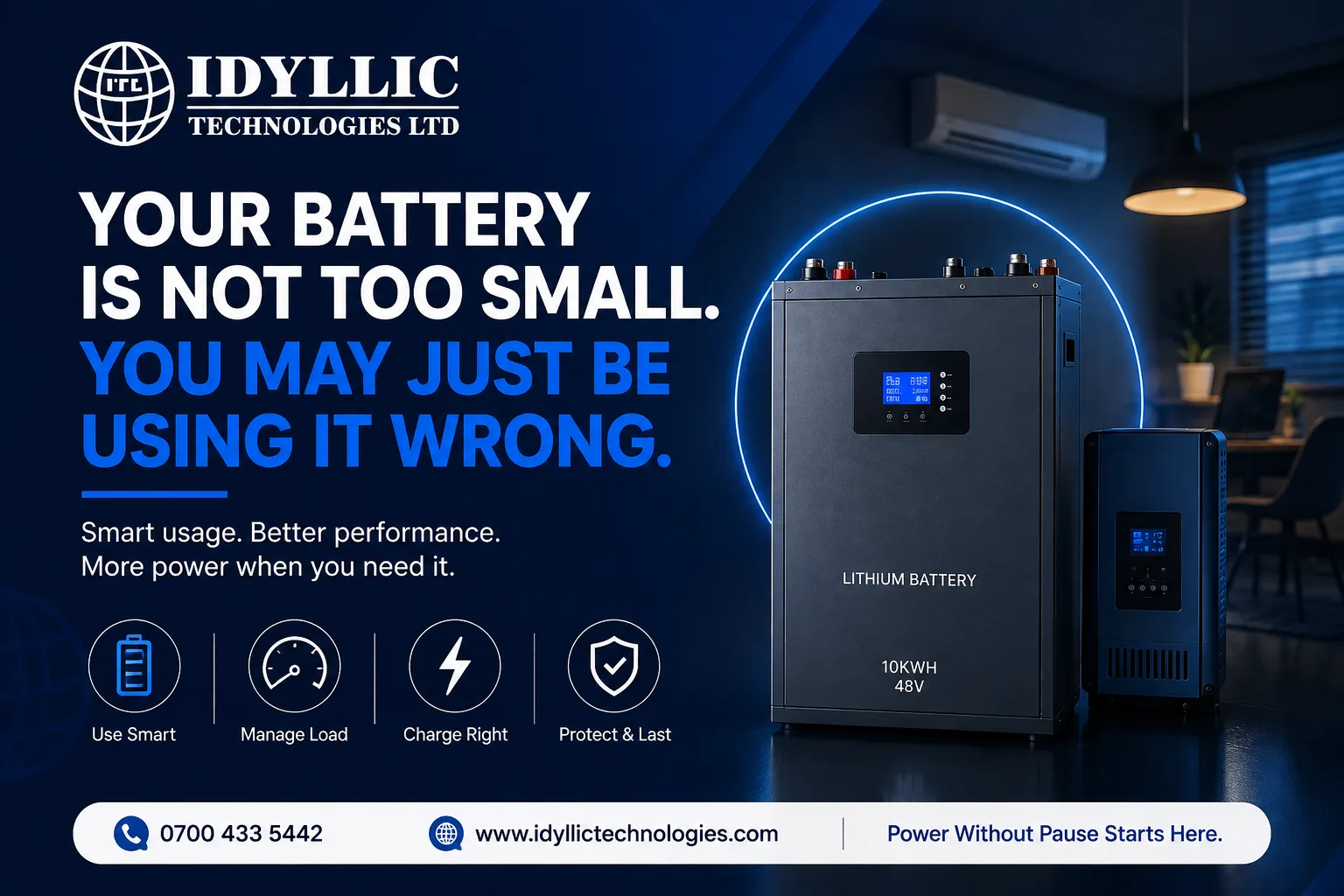
Let’s say you have a 10kWh solar battery.
It is easy to think:
“10kWh means I can run my appliances for 10 hours.”
Unfortunately, it doesn’t work that way.
The amount of time your battery lasts depends on how much power you’re using at any given time.
A small office running lights, computers, Wi-Fi equipment and a few essential appliances will use energy very differently from a home running multiple air conditioners, refrigerators, televisions, pumps and other heavy appliances.
Same battery.
Completely different experience.
This is why simply asking “How many hours will this battery last?” isn’t enough.
The better question is:
“What exactly am I trying to power?”
The Load Is Often the Real Problem
Your battery may be perfectly capable of doing its job.
But if you connect several high-energy appliances to it at once, you can drain it much faster than expected.
Think about a typical Nigerian home or business.
You might have:
Air conditioners
Refrigerators and freezers
Water pumps
TVs
Computers
Printers
Lighting
Fans
Microwaves
Electric kettles
Servers and networking equipment
Now imagine switching several of them on at the same time.
Your battery isn’t necessarily failing.
You’re simply asking it to work harder.
This is why proper load assessment and energy management should happen before choosing a solar battery or inverter system.
A 10kWh Battery Doesn’t Always Give You 10kWh of Usable Energy
Here’s another part many people don’t consider.
Battery capacity and usable battery capacity are not always the same thing.
Battery systems are designed with operating limits to protect the cells and support battery longevity.
One important concept here is Depth of Discharge (DoD), essentially, how much of a battery’s stored energy can be used before it needs to be recharged.
So when comparing batteries, don’t look only at the number printed on the box.
Look at the bigger picture:
Capacity + usable capacity + DoD + efficiency + battery chemistry + expected cycle life.
That’s where the real comparison begins.
Your Inverter Matters Too
Here’s something people sometimes forget:
Your battery and inverter are a team.
A good battery connected to an unsuitable inverter can still produce a disappointing experience.
The inverter determines how much power can be drawn from the battery and converted into usable AC power for your appliances.
So you need to consider both:
How much energy you need
and
how much power you need at once.
Those are two different things.
A system can have enough battery capacity but still struggle with a heavy load if the inverter isn’t appropriately sized.
That’s why simply saying:
“I need a bigger battery.”
may not solve the actual problem.
How You Charge Your Battery Matters
Your battery also needs the right charging conditions.
Poor charging practices, incorrect settings, unsuitable charging equipment or an improperly designed system can affect battery performance and longevity.
For solar systems, the relationship between the solar panels, charge controller, inverter and battery matters.
If your battery isn’t consistently receiving enough energy to recharge properly, you may wake up to a battery that never fully recovered from the previous day’s usage.
And then you blame the battery.
Sometimes, the battery is simply waiting for a better recharge.
Heat Is Not Your Battery’s Best Friend
Nigeria’s climate makes this especially important.
Batteries operate within recommended temperature ranges, and excessive heat can negatively affect battery performance and lifespan.
Where the battery is installed matters.
Ventilation matters.
Installation quality matters.
The surrounding environment matters.
A battery isn’t just something you put in a corner and forget about.
It is an energy storage system that needs to operate under suitable conditions.
So, Are You Actually Using Your Battery Wrong?
Maybe.
Before replacing your battery, ask yourself:
1. What appliances are connected to it?
Are you powering essential loads or everything in the building?
2. What is your actual energy consumption?
Do you know how much electricity your appliances consume?
3. Is your inverter correctly sized?
Can it comfortably handle the loads you’re connecting?
4. Is the battery being charged properly?
Is your solar system providing enough energy to recharge it?
5. What is the battery’s usable capacity?
Don’t look at the headline kWh figure alone.
6. Where is the battery installed?
Is it exposed to excessive heat or poor ventilation?
7. Is the battery still healthy?
Age, usage patterns and operating conditions can all affect battery performance over time.
But Sometimes, Your Battery Really Is Too Small
Let’s be fair.
Sometimes the battery is the problem.
If your energy requirements have increased since the system was installed, your original battery may no longer be enough.
Maybe your business has added more computers.
Maybe you’ve installed additional air conditioners.
Maybe you’ve added refrigeration equipment.
Maybe you’re working longer hours.
Or maybe your household simply uses more electricity than it did before.
Your energy needs can change.
And when they do, your battery storage system may need to change with them.
The important thing is to find out why the battery isn’t lasting before spending money on another one.
Stop Guessing. Start Understanding Your Energy.
The goal isn’t simply to buy the biggest battery you can afford.
The goal is to have a properly designed energy system that matches your actual needs.
Because a larger battery connected to the wrong system isn’t necessarily a better solution.
And replacing a perfectly healthy battery when the real problem is excessive load, poor charging, incorrect sizing or inefficient energy use can become an expensive mistake.
Your battery might not be too small.
You might simply be asking it to do too much.
Before you buy another battery, understand your energy.
Understand your load.
Understand your system.
Then make the decision.
Need help understanding your energy requirements?
At Idyllic Technologies, we help businesses and homes assess their energy needs and find suitable backup and renewable energy solutions, from inverters and lithium batteries to complete solar power systems.
Because reliable power doesn’t start with buying more equipment.
It starts with understanding what you actually need.
Power Without Pause Starts Here.