Your business has more people, more equipment, more customers and bigger plans than it did when you started.
But there is one thing that often gets overlooked as a business grows: energy.
The power system that was enough for you two or three years ago may not be enough for the business you are running today.
Maybe you’re adding more air conditioners. Maybe you’ve bought new equipment. Perhaps your operating hours have increased, or you’ve expanded into a larger facility.
Yet when power goes out, you’re still relying on the same setup you had when the business was smaller.
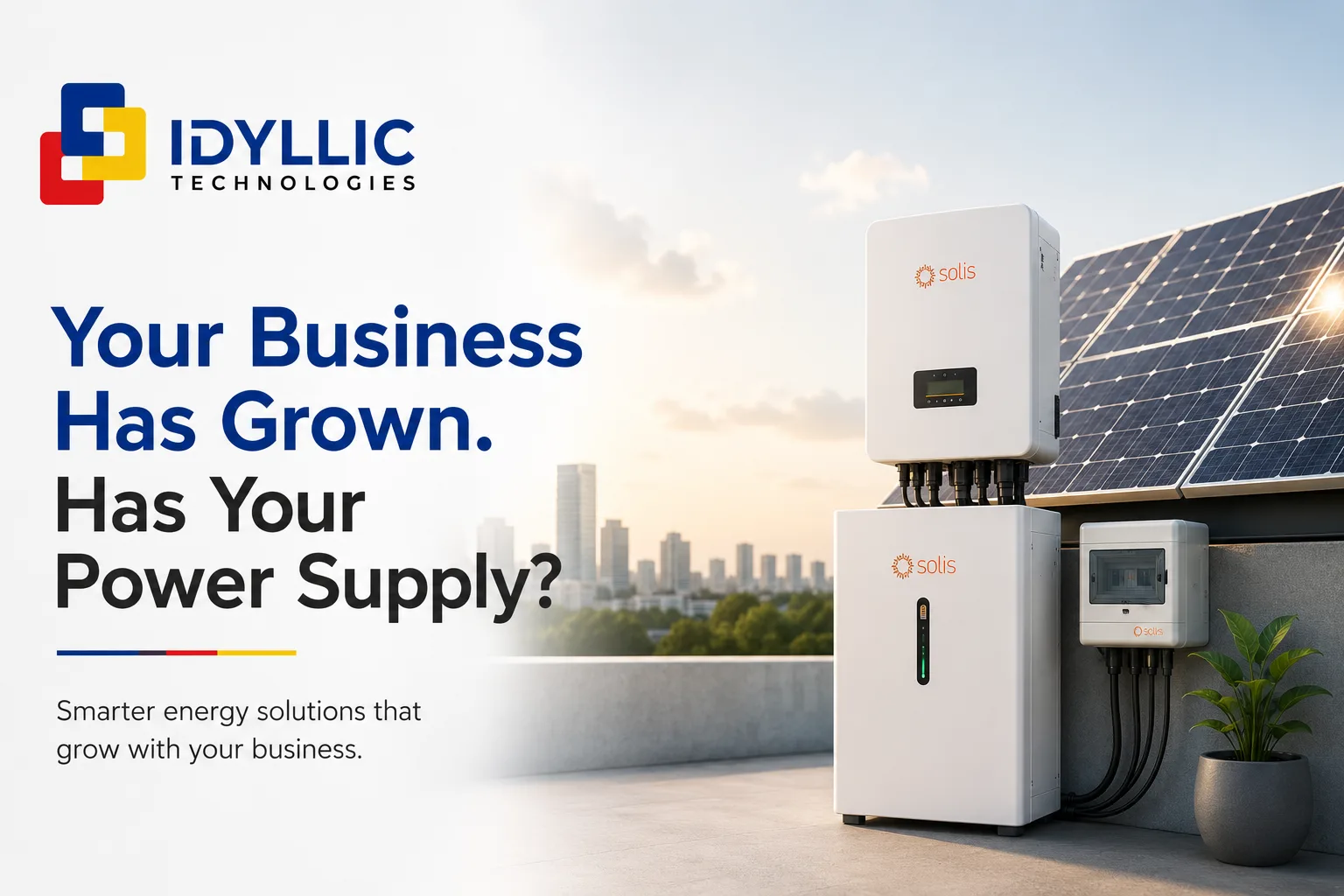
Your business has grown. Has your power supply?
For businesses in Nigeria, this is more than an electricity question. It is a business continuity question.
When Your Business Grows, Your Energy Needs Grow Too
Business growth doesn’t always come with an obvious increase in electricity demand.
You hire more employees.
You add more computers.
You expand your office.
You purchase new equipment.
You stay open longer.
You increase production.
Individually, these changes may not seem significant.
Together, they can completely change your business’s energy requirements.
A power system designed for yesterday’s business may struggle to support today’s operations.
And that’s when businesses can begin experiencing problems such as shorter backup times, overloaded equipment, frequent generator use or the inability to power new loads.
The issue isn’t necessarily that your power system is bad. It may simply no longer match your business.
How Do You Know When Your Power System Is No Longer Enough?
You don’t necessarily have to wait for a major failure.
There are signs.
Your battery backup doesn’t last as long anymore
If your business has added more loads but your battery capacity hasn’t changed, the available stored energy has to support more equipment.
That can mean shorter backup periods.
Your inverter is constantly under pressure
An inverter should be properly matched to the loads it is expected to handle.
As businesses expand, additional equipment can push an existing solar inverter closer to its operating limits.
You keep adding generators or other backup sources
If your business is constantly finding another way to keep essential equipment running, it may be time to look at your entire energy strategy rather than adding another temporary solution.
You can’t comfortably add new equipment
This is a big one.
If every new machine, air conditioner or piece of equipment comes with the question, “Will our current power system handle this?”, your energy infrastructure may already be holding the business back.
Your Business Doesn’t Just Need More Power. It Needs the Right Power.
When energy demand increases, the answer isn’t always to simply buy a bigger inverter or add more batteries.
First, you need to understand how your business actually uses electricity.
A proper energy assessment should consider things like:
Your current energy consumption
Peak loads
Critical equipment
Operating hours
Daytime and nighttime usage
Existing grid supply
Battery requirements
Solar potential
Future expansion plans
This is what separates a properly designed commercial solar system from simply buying individual pieces of solar equipment.
The goal is to build a system around the business — not force the business to work around the system.
Solar Can Do More Than Keep the Lights On
For many Nigerian businesses, solar power is still seen primarily as a backup option.
But that picture is changing.
A properly designed solar energy solution for businesses can become part of the business’s everyday energy strategy.
Solar panels can generate electricity during the day.
A battery energy storage system can store energy for later use.
A modern solar inverter can manage the interaction between solar generation, batteries, grid power and business loads, depending on the system configuration.
Together, these technologies can give businesses more control over how they generate, store and use electricity.
That is a much bigger conversation than simply asking:
“What happens when NEPA goes off?”
The better question is:
“How should our business manage its energy?”
Why Battery Storage Matters for Growing Businesses
Solar generation is only one part of the equation.
For businesses that need reliable power beyond daylight hours or during outages, battery storage can be an important part of the system.
But battery capacity shouldn’t be chosen simply because a larger battery sounds better.
The right capacity depends on what you need to power and for how long.
For example, a business may prioritize critical loads such as:
Computers and IT equipment
Internet and networking systems
Security systems
Essential lighting
Refrigeration
Selected office equipment
Critical machinery
This allows the system to focus available stored energy where it matters most.
For a growing business, that kind of energy planning can make a significant difference.
Your Solar Inverter Is Part of the Bigger Picture
The inverter is one of the most important components of a modern solar power system.
But choosing one shouldn’t come down to looking at the highest number of kilowatts you can afford.
The inverter needs to work with the solar panels, battery system, loads and overall energy strategy.
Modern inverter systems can offer capabilities such as:
Solar energy conversion
Battery integration
Backup power
Grid interaction
Intelligent energy management
Remote monitoring on supported systems
This is why businesses considering solar inverters in Nigeria should look beyond the product specification and consider how the inverter fits into the complete system.
What If Your Business Is Still Using a Generator?
Moving toward solar doesn’t necessarily mean abandoning every other source of power.
For many Nigerian businesses, a more practical approach is to create a balanced energy system.
Solar can supply part of the business’s electricity needs.
Battery storage can provide stored energy when required.
The grid can remain part of the mix.
And a generator can provide additional backup when circumstances demand it.
The objective is not necessarily to eliminate every other power source immediately.
It is to reduce dependence on a single source and gain greater control over your energy.
Don’t Build Only for Today’s Business
Here’s something worth thinking about before investing in a new power system:
Where will your business be in three to five years?
You may be planning to:
Add new equipment
Increase production
Expand your office
Open another branch
Extend operating hours
Add more staff
Increase your cold storage capacity
Move into a larger facility
Those plans can significantly change your energy requirements.
That is why scalability should be part of the conversation when designing renewable energy solutions for businesses.
A system that can accommodate future growth can be more useful than one designed around today’s requirements alone.
Solar Should Support Your Business, Not Become Another Problem
A solar installation is an investment.
And like any business investment, it should solve a real problem.
The right system should answer questions such as:
What does the business need to power?
How much energy does it actually consume?
Which loads are critical?
How much backup is required?
What role should batteries play?
How much solar capacity makes sense?
What happens as the business grows?
These questions matter because there is no single solar system for businesses in Nigeria that works for everyone.
An office, hotel, school, retail store, healthcare facility and manufacturing operation can all have very different energy profiles.
The best solution is the one designed around the business.
Your Energy Strategy Should Grow With Your Business
Your business shouldn’t have to wait for another major power problem before reconsidering its energy system.
If your operations have changed, your energy requirements may have changed too.
And that may be the right time to look beyond simply adding another backup option.
Solar power, battery storage and modern inverter technology can give growing businesses a smarter way to generate, store and manage energy.
The goal isn’t simply to have more electricity.
It is to have an energy system that makes sense for where your business is today — and where it is going next.
Powering the Business You’re Building
At Idyllic Technologies, we understand that businesses don’t all use energy in the same way.
As a renewable energy and backup solutions company, we provide solar, inverter and battery solutions designed around the energy requirements of residential, commercial and business customers.
Whether you’re looking to improve your existing backup system, introduce solar power into your operations, integrate battery storage or build a more scalable commercial solar solution, the starting point should always be understanding your business.
Because your business has grown.
Your power strategy should grow with it.
Ready to rethink your business’s energy?
Talk to Idyllic Technologies about a solar and backup power solution designed around your business.